
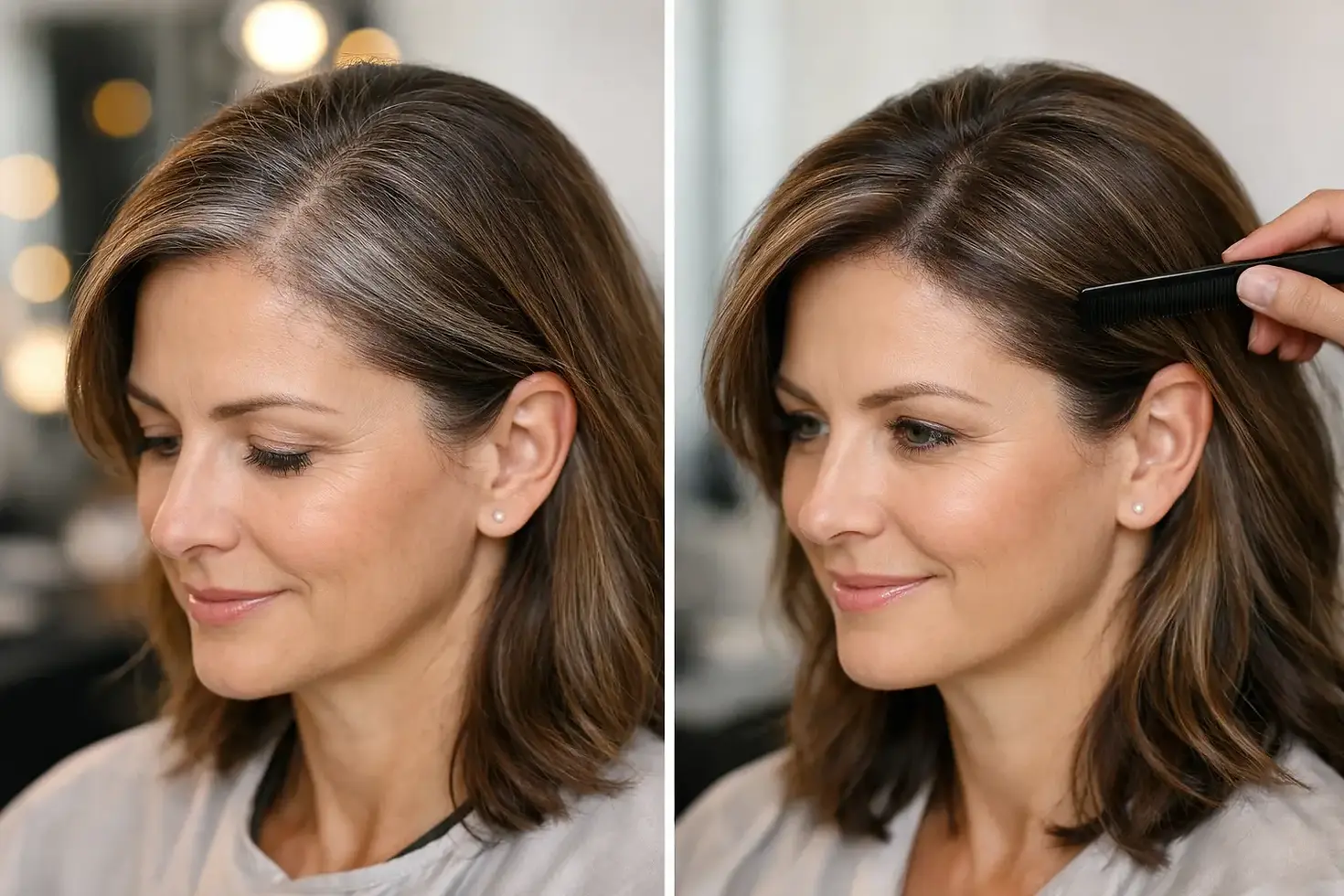
Grey Blending for Front Hairline Regrowth

The front hairline is usually the first place clients notice regrowth and the hardest area to keep looking soft. If your roots show most around the face, grey blending for front hairline regrowth can make a real difference because it reduces that sharp line of contrast without forcing you into heavy all-over colour.
For many women, this is not about covering every grey. It is about making the regrowth less obvious, keeping the result flattering, and avoiding that dense block of colour that can look too solid against the skin. Around the hairline especially, a softer approach often looks more modern and is easier to maintain.
Why the front hairline shows regrowth first
The front catches the light, frames the face and gets the closest attention in the mirror. Even when the rest of the hair still looks fresh, the temples and front parting can start to look brighter, whiter or more uneven quite quickly.
Texture matters too. Greys at the hairline can be more resistant, more wiry, or simply more visible because the hair is finer around the face. That means a single-process tint does not always fade evenly there, and in some cases it can leave a noticeable line as the natural hair grows through.
This is one reason many clients ask for a more natural-looking alternative. They do not want to feel tied to frequent root appointments just because the front section gives everything away.
What grey blending for front hairline regrowth actually means
Grey blending is not the same as full grey coverage. Instead of trying to completely block out every silver strand, the colour is adjusted to soften the contrast between your natural regrowth and your existing colour.
At the front hairline, that can involve carefully placed lowlights, softer demi-permanent colour, fine face-framing detail, or a combination of techniques depending on how much grey you have and how bold your current colour is. The goal is a more diffused finish, so the regrowth looks less harsh as it comes through.
The best result depends on your starting point. Someone with naturally dark hair and a bright white front section needs a different approach from someone with a softer salt-and-pepper pattern. If your lengths are balayaged or already broken up with dimension, blending is often easier. If your colour is very flat and solid, the first appointment may need a bit more correction to create softness.
Grey blending for front hairline regrowth vs full root coverage
There is no single right option here. It depends on how you like your colour to look and how often you want to maintain it.
Full root coverage gives a denser result. It can work well if you prefer your hair to read as one even shade from roots to ends. The trade-off is that regrowth usually appears more defined, especially around the temples and parting.
Grey blending for front hairline regrowth is often better for clients who want something less obvious between appointments. Because the colour is softer and more dimensional, the new growth tends to come through in a gentler way. You may still see your greys, but they do not announce themselves as a strong line.
This is particularly useful for busy professionals who want polished colour without feeling as though they need a root retouch every few weeks. In a one-to-one salon setting, the colour plan can be tailored so the front hairline is treated as its own area rather than as an afterthought.
Who this approach suits best
The most successful grey blending usually happens when the goal is realistic. If you want zero visible grey at any point, blending may feel too soft for you. If you want lower maintenance, a more natural grow-out and a less solid colour line, it often makes much more sense.
It suits clients who are starting to see more grey at the temples, clients growing out heavy tint, and clients who feel their current root colour looks too dark or too flat around the face. It can also be a very good option if your hair condition needs protecting, because repeated full-strength permanent colour on the front hairline is not always the gentlest long-term plan.
For clients in Bethnal Green, Hackney and nearby parts of London who want a polished result without that obvious helmet-like root line, this is often the more flattering route.
How the colour plan is chosen
A specialist will usually look at four things first: your natural base, the percentage of grey, the tone in your existing lengths, and how quickly your regrowth bothers you.
If your natural hair is quite dark, adding softness through fine dimension is often more believable than applying a flat dark shade over everything. If your lengths are lighter, the front hairline can often be blended with delicate brightness and lowlights so the silver sits more naturally within the overall colour.
Skin tone also matters. Around the face, overly ashy or overly dense colour can make the result look harsh. The front hairline should complement your complexion, not sit on top of it as a separate block.
This is where experience matters. Hairline work is precise. A good blend should look effortless, but it is rarely accidental.
What to expect at your appointment
If this is your first move away from full coverage, the appointment may be less about one quick fix and more about shifting the colour direction properly. That can mean softening old banding, breaking up a solid root area, and refining the front sections so they grow out more gently.
In some cases, a demi-permanent gloss at the hairline is enough. In others, micro-fine lowlights or subtle face-frame work are needed to stop the grey from sitting too starkly against previously coloured hair. The right method depends on whether your current issue is brightness, patchiness, warmth, or a hard line of regrowth.
Healthy hair should stay part of the plan. If the front sections are fragile or have been repeatedly coloured, pushing for maximum coverage can leave the hair looking dull or overworked. A softer blend often gives a better finish and better condition at the same time.
Maintenance between visits
The main benefit of a blended hairline is that it buys you flexibility. You are less likely to feel caught out by a bright stripe of regrowth after a few weeks.
That does not mean no maintenance at all. Toning, glossing and refresh appointments can help keep the front looking polished, especially if your hair is naturally dark or your greys are very bright. Purple shampoos are not always the answer either. Used too often, they can leave lighter pieces dull or flat rather than expensive-looking.
Good home care matters more than people think. Heat protection, gentler cleansing and the right repairing treatments help colour stay more even, especially on finer hair around the face. If your hairline is prone to dryness or frizz, smoothing the finish properly can also make regrowth appear less prominent.
When grey blending is not enough on its own
There are times when blending needs to be paired with something else. If your previous colour is very dark and solid, or if there is a strong band from old root applications, the first session may need a colour correction mindset rather than a simple refresh.
Likewise, if your grey is concentrated only at the very front and the rest of the hair is much deeper, the challenge is creating harmony. Too much softness can look disconnected. Too much coverage can look heavy. This is where tailored placement matters most.
Clients who have had disappointing colour elsewhere often assume their only options are dark root coverage or giving up and going fully grey. There is usually more room in the middle than that. A carefully planned blend can keep the result refined, wearable and much kinder in grow-out.
A softer hairline can change the whole colour
The front hairline is a small area, but it affects how your whole colour reads. When that section is too solid, too warm or too sharply contrasted, the entire result can feel less natural. When it is softened properly, everything looks more expensive and more considered.
That is why grey blending at the hairline is often one of the most worthwhile adjustments for clients wanting lower-maintenance colour in East London. It keeps your look polished without forcing an all-or-nothing approach.
If your regrowth is most obvious around the face, the answer is not always more colour. Sometimes it is better colour placement, better tone choice and a plan that works with the way your hair actually grows.
A calm, personalised approach nearly always gives the best result - especially when the goal is hair that still looks like you, just fresher and more balanced.
See Real Results
Explore real client results from Sara Styles Hair in East London: View on Instagram
Book Your Appointment
Book your appointment at Sara Styles Hair in Bethnal Green, East London: Book Now


Comments